
How to Start a Career in Health and Life Sciences: A Practical Guide for Beginners
Learn how to transition into health and life sciences by building digital confidence, understanding the NHS and using your existing strengths to start a purposeful career.


If you are considering a move into health and life sciences, I want to start by saying something clearly. You can do this. The sector is full of people who began in completely different fields and found their feet by leaning into curiosity, purpose and learning. It is growing fast in the UK and there is real space for individuals who care about improving healthcare and who want to build something meaningful.
This guide is here to give you practical steps, but also the confidence to believe that you belong here. Because if you care about people, technology, science, problem solving or simply making our healthcare system better, you already have the foundations to build a successful career.
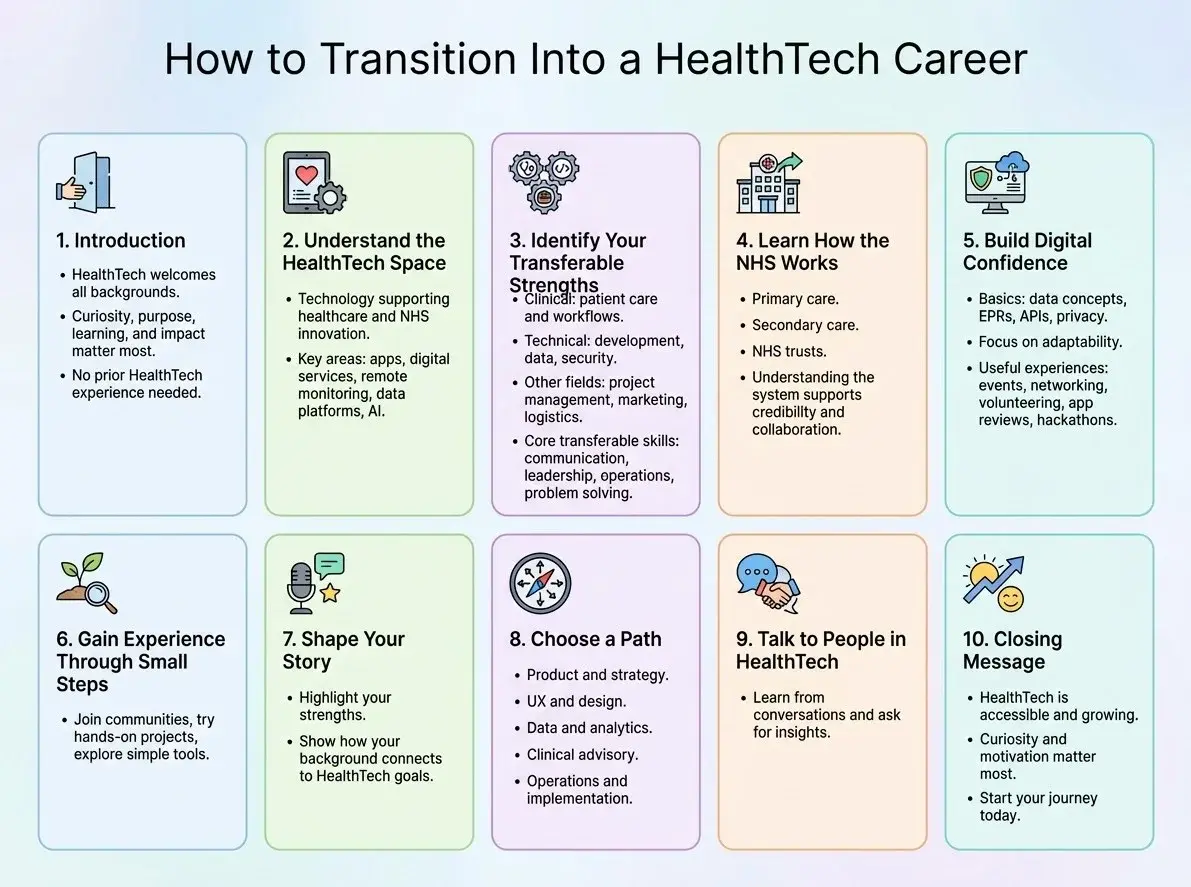
Start by Understanding the Space
Before you take your next step, spend a little time exploring what health and life sciences actually covers. At its simplest, it is the work of keeping people healthy and helping healthcare professionals deliver care more effectively. That spans digital health apps and remote monitoring, the medical devices and diagnostics used in hospitals and labs, the pharma and biotech companies developing new therapies, and the contract research organisations (CROs) that run the trials behind them.
The exciting part is that this is not one narrow sector. It is a collection of many interconnected roles and disciplines. There are opportunities in product management, clinical work, engineering, regulatory affairs, quality, clinical operations, data, design, customer success and strategy. If healthcare and the people who improve it intersect anywhere, it usually sits within this sector.
If you want an advantage, look at what is happening across the NHS, because so much innovation in the UK is driven by NHS needs, even in companies that never touch a hospital directly. When you understand the problems that matter, it becomes easier to see where your skills can fit in.
Identify What You Already Bring
One of the biggest misconceptions is that you must be an engineer or a clinician to work in this sector. This is simply not true. It thrives on diversity of experience, because healthcare is complex and requires many different viewpoints.
If you come from healthcare, you bring patient understanding and clinical insight. If you come from technology, you bring digital thinking, structure and problem solving. If you come from science, you bring rigour and an evidence mindset. If you come from something entirely different, you might bring communication, leadership, service experience or operational excellence.
I always encourage people to ask themselves one simple question. What strengths do I have that would help someone receive better care, or help a team deliver care more easily? Your answer to that question will often reveal your value.
Learn How the System Works
Because so much of this sector in the UK is tied to the NHS and to the regulators around it, take a little time to understand how it is organised. You do not need to become an expert. You simply need enough awareness to understand where products and therapies fit in.
Look into the difference between primary care and secondary care, how referrals happen, what an NHS Trust is and why waiting times and digital access matter. If you are drawn to devices, diagnostics or medicines, learn the basics of how the MHRA regulates products and how NICE shapes adoption. When you know the environment your future product or service will sit within, you become more credible and more effective in your role.
Build Digital Confidence
Much of the sector is built on technology, but you do not need to be highly technical to be successful. What does help is digital confidence. This means feeling comfortable exploring new software, learning how systems work and adapting to new tools.
If you are non technical, start small. Learn about data basics, electronic patient records, user journeys, APIs or digital privacy principles. If you already work in tech, aim to understand the specific systems and standards used in healthcare.
Digital confidence tells employers something important. It tells them you are adaptable, curious and capable of learning quickly. Those qualities matter more than programming languages.
Create Small but Meaningful Experience
You do not need your first job in the sector to get experience in it. You can build it yourself. Here are a few simple ways to start.
Attend a digital health or life sciences event. Analyse your favourite health app and write a short review. Join a community discussion. Volunteer with an organisation using digital tools. Participate in a design sprint or a hackathon. Study a patient journey and sketch what could improve it.
None of these things require you to be employed in the sector, yet each one gives you genuine exposure that employers value. They show that you are proactive, engaged and already thinking like someone in the industry.
Shape a Story That Makes Sense
When you apply, your story matters. Companies in this sector want people who care about the mission and who understand why this work is important. Use your CV and cover letter to highlight moments where you solved problems, improved systems, supported people or used data to make decisions. Those experiences translate beautifully into healthcare environments.
Be open about why you want to move into the sector. It could be a personal experience with the NHS, a desire to work on meaningful problems or an interest in science and technology that improves lives. Authenticity always resonates.
Choose a Path That Aligns With You
This sector has space for many types of roles. If you enjoy structure and planning, operations or project management could be ideal. If you love design and user empathy, user experience work might be the right fit. If you think strategically, product roles could suit you. If you thrive in data or analysis, there is a huge need for that too. If you are meticulous about detail and evidence, regulatory, quality or clinical operations roles are worth exploring. If you come from healthcare, clinical advisory or pathway design roles can be a natural transition.
The important thing is to choose a path that aligns with your strengths and interests, because that is where you will grow fastest.
Talk to People Already Working in the Sector
Connections matter. The health and life sciences community in the UK is welcoming, collaborative and full of people who want to support others entering the space. Speak to someone in a role you find interesting. Ask what their day looks like, what surprised them and what they wish they had known earlier.
These conversations often give you insight that you cannot get from job descriptions. They also build confidence and open doors you may not have realised were there.
Final Thoughts
Transitioning into health and life sciences is not about having the perfect background. It is about being willing to learn, being curious about the future of healthcare and being excited about doing work that genuinely helps people. The sector needs thinkers, builders, carers, communicators and problem solvers. Most importantly, it needs people who believe that healthcare can be better than it is today.
If you are ready to make the move, start small, stay open minded and trust that your skills have a place here. The UK health and life sciences community is growing, energetic and full of opportunity. You can absolutely be part of it.