
NHS vs Private Physiotherapist: An Honest Comparison
The real differences between NHS and private work: pay, conditions, autonomy, variety, and career development.

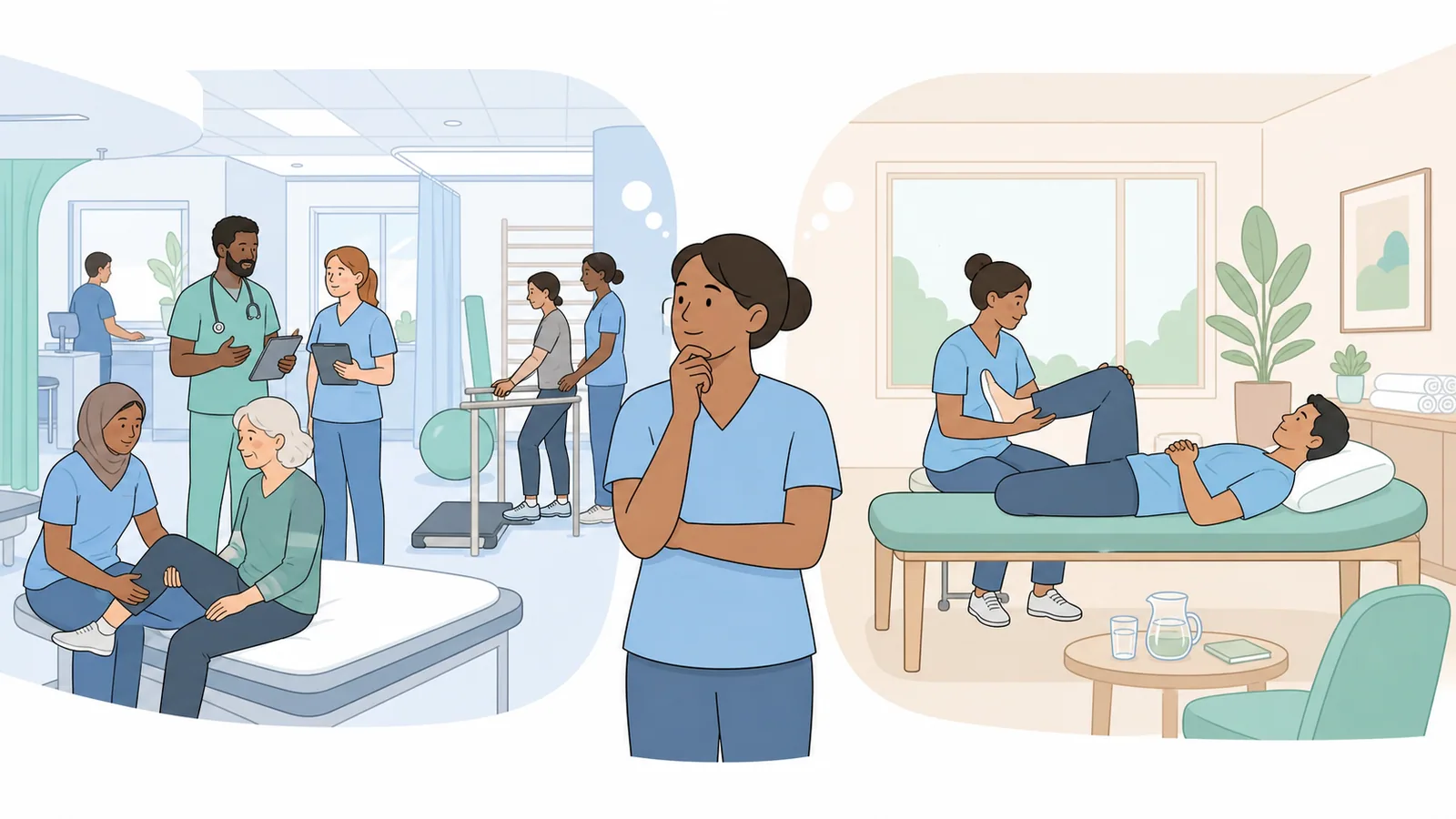
Most physiotherapists ask this question at some point: would the private sector suit me better?
The internet makes it sound simple. Private pays more, NHS has the pension, pick one. The reality is messier. I see physiotherapy hiring from both sides through Meeveem, and this is the honest version.
The pay comparison
Start with what the numbers actually say.
In the NHS, a newly qualified physiotherapist enters at Band 5, earning £32,073 to £39,043. Move into a specialist role at Band 6 and that becomes £39,959 to £48,117. Reach Band 7 as an advanced practitioner or team lead and you are looking at £49,387 to £56,515. If you work in London, add the high-cost-area supplement: 20% for inner London, 15% for outer London, 5% for the fringe. You can model your exact figure on the NHS Pay Calculator.
Private sector pay is harder to pin down because it varies more. A physiotherapist at a provider like Bupa or Nuffield typically earns £38,000 to £45,000. Senior or specialist roles in private settings tend to sit between £45,000 and £55,000. Go self-employed or locum and you might charge £30 to £50 an hour, depending on your specialism and location.
On paper, the NHS often pays more at the lower bands. Private catches up, and sometimes overtakes, at senior levels. The real comparison is more complicated than base salary.
The pension question
The NHS Pension Scheme is often the factor that keeps people in the service longer than they planned.
It is a defined benefit scheme: your retirement income depends on salary and years of service, not stock market performance. Your employer contributes around 24% on top of your salary. That contribution is invisible on your payslip but it is real money. For a Band 6 physiotherapist, it is worth roughly £8,000 to £10,000 a year.
Private employers typically offer defined contribution pensions. The legal minimum is 3% from the employer. Some offer 5% to 8% for senior roles. Even at the generous end, it is worth less than the NHS scheme. The gap compounds over a career.
If you plan to work until retirement and value certainty, the NHS pension is hard to beat. If you plan to move between sectors, go abroad, or retire early, the calculation changes.
Caseload and autonomy
This is where the day-to-day experience diverges most.
NHS physiotherapists often carry high caseloads. Waiting lists mean pressure to see more patients in less time. Your autonomy within a session can feel limited when the system is moving you to the next patient. Specialisms like MSK, neurology, respiratory, and paediatrics are all available in the NHS, but you may need to rotate through generalist work first.
Private physiotherapists typically have longer appointment times: thirty or forty-five minutes, compared to fifteen or twenty in some NHS settings. You have more control over your schedule and treatment approach. The tradeoff is that caseloads skew toward certain conditions. Private MSK work is abundant. Complex neurological rehabilitation is less common outside specialist units.
If you want variety and complexity, the NHS often has more of it. If you want time with each patient and control over your working day, private tends to offer more of that.
Working hours
NHS physiotherapy roles are usually full-time, Monday to Friday, though some trusts now run seven-day services. On-call and weekend rotas exist in acute settings. The predictability varies by setting, and some specialisms are more demanding than others.
Private clinics often run extended hours to fit around patient work schedules. Saturday mornings are common. Some private employers offer genuine flexibility in return, including compressed weeks or part-time options that are harder to negotiate in the NHS. Self-employment gives you the most control, at the cost of the most admin.
Neither sector has a monopoly on work-life balance. The difference is in what you are trading for it.
Job security
The NHS is not going anywhere. Your role might change, your banding might be reviewed, restructures happen. Redundancies are rare. The system absorbs staff even when individual services shrink.
Private employers are businesses. They grow and contract. The big providers are stable enough, but smaller clinics can close, and your notice period is whatever is in your contract. Self-employment carries its own risk: income depends on referrals and reputation, and there is no sick pay.
If security matters to you, the NHS offers more of it. If you are comfortable with some uncertainty in exchange for other benefits, private can work well.
Career progression
In the NHS, the path is mapped. Band 5 to Band 6 takes roughly two to four years. Band 6 to Band 7 takes another four to six. Advanced practice, consultant roles at Band 8a and above, First Contact Practitioner posts in GP surgeries: these are all established routes with clear criteria. You can read the full breakdown in the physiotherapist career path guide.
In private, progression is less structured. Senior roles exist, clinical lead positions open up, but the ladder has fewer rungs and promotion depends more on the individual employer. Some physiotherapists find this freeing. Others find it unclear.
A common pattern is to train and specialise in the NHS, then move into private once you have the credentials. The NHS gives you the breadth. Private can give you the income once you know what you want to do.
Making the decision
There is no right answer here. There is only the answer that fits what you want.
If you value pension security, clinical variety, and a clear progression route, the NHS probably suits you better. If you value patient time, schedule control, and potentially higher income at senior level, private is worth considering. Many physiotherapists do both at different stages, and some work across sectors at the same time.
Start by getting clear on what matters to you, then look at actual roles. You can see what is out there on the physiotherapist jobs page.
FAQ
Is private physiotherapy better paid than NHS?
It depends on the level. At Band 5 and Band 6, NHS base salaries are often higher than equivalent private roles. At senior and specialist level, private can match or exceed NHS pay, especially for self-employed work. Factor in the NHS pension, worth roughly 24% of salary in employer contributions, and the NHS is often ahead on total reward until you reach the top end of private practice.
Can I work in both NHS and private at the same time?
Yes. Many physiotherapists hold a part-time NHS contract and do private work on the side. Check your NHS contract for any restrictions on secondary employment, and be clear about your working hours to stay within safe limits. HCPC registration covers you for both.
Is job security better in the NHS?
Generally, yes. NHS redundancies are rare and the system is stable. Private employers are businesses and carry more risk, particularly smaller clinics. Self-employment offers no safety net at all. If security is important to you, the NHS provides more of it.
What specialisms are available in private physiotherapy?
MSK work dominates private practice. Sports physiotherapy, occupational health, and some women's health work are also common. Complex neurological rehabilitation, paediatrics, and respiratory physio are less available outside the NHS, though some specialist private providers exist. If you want breadth, the NHS typically offers more.
How do I decide which sector is right for me?
Start with what you want: security versus flexibility, variety versus depth, structured progression versus entrepreneurial freedom. Neither sector is objectively better. Look at actual roles in both, compare pay using the NHS Pay Calculator and private job adverts, and talk to physiotherapists who have worked in each. The right answer is personal.