
Pharmacist degree apprenticeship: the honest guide
The pharmacist degree apprenticeship is not approved yet. Here is what exists now, what is proposed, and the routes you can actually apply for.

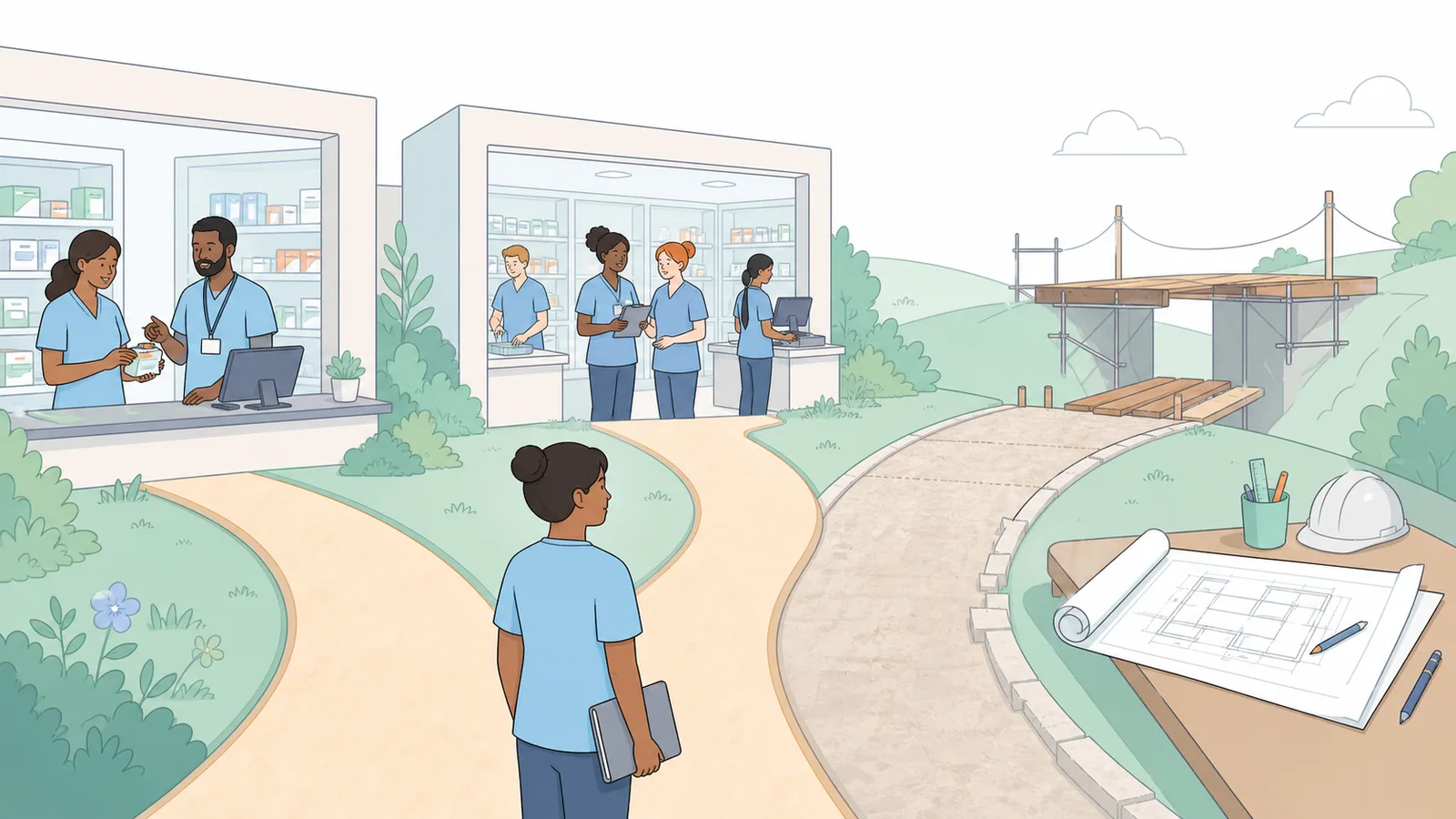
There is no pharmacist degree apprenticeship yet. Here is the honest picture, and the routes that do exist.
If you have been searching for a way to become a pharmacist without the student debt, you have probably seen pages describing a five year pharmacist degree apprenticeship. Some of them are confident about entry requirements, employers and pay. I looked into it properly, and the position is simpler than those pages suggest.
The honest answer
You cannot currently do an apprenticeship that qualifies you as a pharmacist in England.
A Level 7 pharmacist degree apprenticeship has been talked about for years, and Skills England does list a "Pharmacist (degree)" standard with a trailblazer group of employers preparing a proposal behind it. It has not been approved. Nobody is recruiting to it. NHS England describes it as under consideration in its workforce planning, which is a long way from a place you can apply for.
That may change. It has not changed yet.
Anyone telling you to apply for a pharmacist apprenticeship this year is describing something that does not exist. If you find a vacancy using that phrase, read it properly before you get your hopes up, because it is almost always a pharmacy technician apprenticeship or a foundation trainee pharmacist post advertised loosely. Different jobs. Different qualifications.
What does exist
Two pharmacy apprenticeships are real, approved and recruiting.
Pharmacy services assistant, Level 2. The entry point. You work in a pharmacy, dispensing under supervision, handling stock and dealing with patients. Around twelve to eighteen months. Few formal entry requirements, usually some GCSEs.
Pharmacy technician, Level 3. The substantial one. Around two years, and it registers you with the General Pharmaceutical Council as a pharmacy technician. You prepare and check medicines, counsel patients, and in many settings run services with real clinical responsibility. Entry is typically four or five GCSEs including maths, English and science, though employers vary.
Both are proper apprenticeships. You are employed, you are paid, your training is funded, and you finish with a recognised qualification. Neither makes you a pharmacist. The pharmacy technician career path guide covers where that role leads.
The actual route to becoming a pharmacist
It runs through university, and it takes five years.
Four years on an MPharm degree, accredited by the General Pharmaceutical Council. One foundation training year afterwards, working in a pharmacy under supervision, which is where most people find out what kind of pharmacist they actually want to be. Then the GPhC registration assessment. Pass it and you are on the register.
The foundation year is where the money question gets interesting, and where a lot of pages get it wrong. See below.
The full route, including entry requirements and what the degree involves, is in how to become a pharmacist.
What the foundation training year actually pays
NHS England funds employers £27,295 for each foundation trainee pharmacist in the 2025/26 training year, up from a previously published £26,500.
Read that sentence carefully, because the number gets misquoted constantly. That money goes to the employer, not to you. NHS England describes it as a contribution to all the costs of hosting a trainee, which includes supervision, administration and salary. Your actual pay is set by whoever employs you.
NHS England sets a minimum within the national recruitment scheme terms, and beyond that, in its own words, each employer works to its own requirements on trainee salary. Your pay therefore varies by employer. Ask them directly.
Applications for foundation training places in England run through Oriel, the national recruitment system, and they open well over a year ahead of the start date.
Can you get in without the debt
Partly, and it takes longer.
The realistic version is to start as a pharmacy services assistant or a pharmacy technician apprentice. You earn from day one. You train at your employer's expense, and you build up several years of genuine practice experience that a school leaver going straight to university simply will not have.
From there, some technicians go on to an MPharm. A few universities will consider relevant experience and qualifications alongside or instead of A-levels, and some technicians study part time while working. You still do the degree. You are just doing it as someone with a wage, a job and a lot of practical knowledge rather than straight from school.
It is slower than four years at university. It carries less debt and more experience. Neither route is better in the abstract.
One thing to watch if the apprenticeship does launch
Level 7 apprenticeship funding changed on 1 January 2026. Government funding now only covers apprentices who are aged 16 to 21 at the start of training, or under 25 with an education, health and care plan or experience of local authority care.
If a pharmacist degree apprenticeship is approved, that funding rule would likely shape who can access it. A career changer in their thirties should not assume a funded place would be available to them.
What to do with this
If you want to be a pharmacist, plan for the MPharm and the foundation year. Look at what pharmacists actually earn before committing five years to it, and at the NHS versus community comparison to work out which setting appeals.
If the debt is the obstacle, look seriously at the technician route. It is a real career in its own right, not a consolation prize, and it keeps the pharmacist door open.
Pharmacy apprenticeship vacancies appear on Meeveem alongside other pharmacy roles.
FAQ
Is there a pharmacist degree apprenticeship in the UK?
No. A standard has been proposed and a trailblazer group has been working on it, but it has not been approved and nobody is recruiting to it. Vacancies advertised as pharmacist apprenticeships are usually pharmacy technician apprenticeships or foundation trainee pharmacist posts.
What pharmacy apprenticeships can I actually apply for?
Pharmacy services assistant at Level 2, and pharmacy technician at Level 3. The technician apprenticeship registers you with the GPhC and takes around two years.
Can a pharmacy technician become a pharmacist?
Yes, by completing an MPharm degree and the foundation training year. Your experience helps with applications and with the work itself. It does not replace the degree.
How much do foundation trainee pharmacists get paid?
It depends on the employer. The £27,295 figure you may have seen is what NHS England pays the employer to host a trainee, covering supervision and administration as well as salary. NHS England sets a minimum through the national recruitment scheme and leaves the rest to employers, so ask directly.
Do I still pay tuition fees on the MPharm?
Yes. The MPharm is a standard undergraduate degree with the usual fees and student finance. The debt-free route into pharmacy is the technician apprenticeship, which is a different qualification.
Plan for the route that exists rather than the one that might. If the apprenticeship is approved, it will be widely announced, and it will still be there when you are ready.