
How NHS pay progression actually works
NHS pay rises in two different ways: pay steps inside your band and promotion above it. What each one asks of you, and what is not automatic.

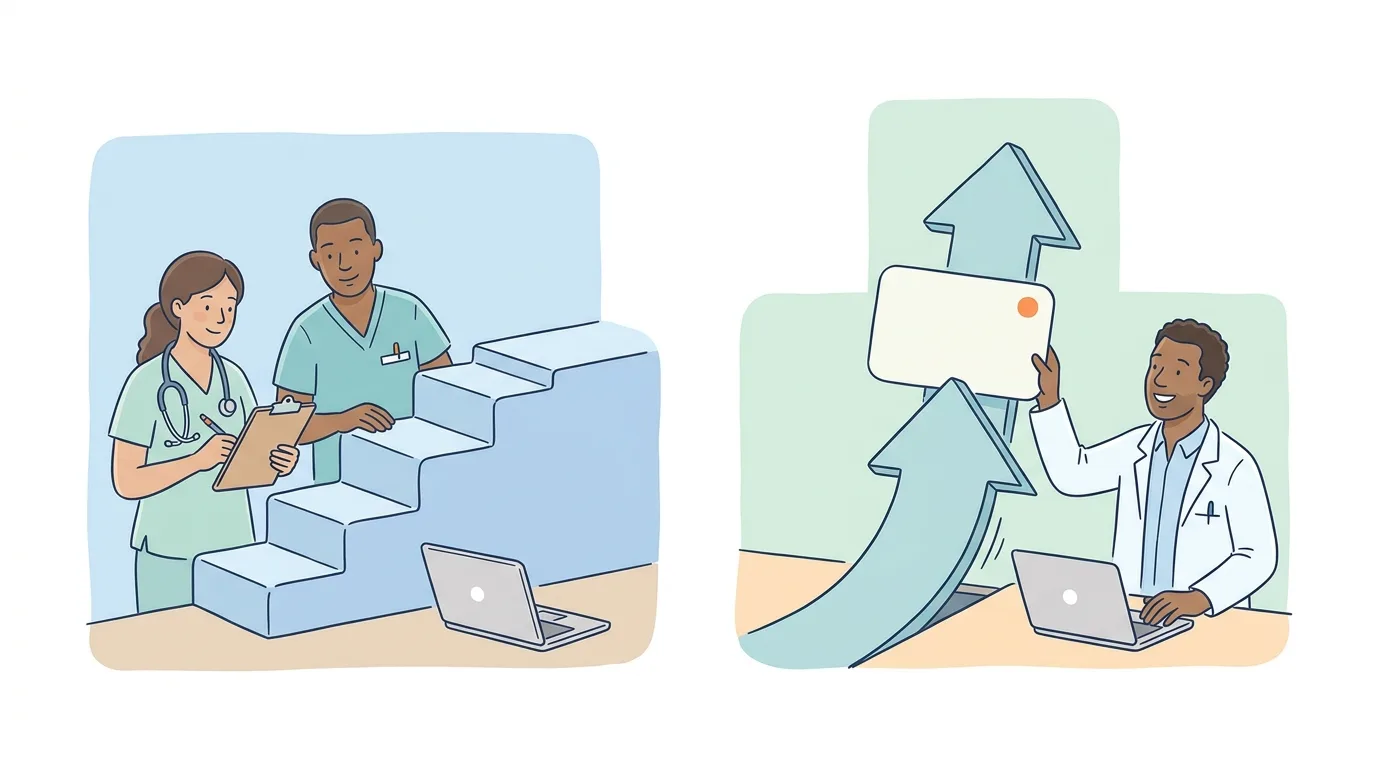
Your NHS pay rises in two completely different ways, and only one of them happens without you doing anything.
I see UK health hiring every day through Meeveem, which puts NHS pay in front of me alongside private and bank rates. The question that comes up most is some version of "when does my pay actually go up", and hardly anyone has ever had it explained to them properly, mostly because the two mechanisms that raise it get muddled into one. Here is the plain version.
This is general information about how the system works. It is not financial advice.
The two ways your pay goes up
Inside your band, you step up pay points over time. That is the quiet one, and it carries on in the background whether or not you ever apply for another job in your life.
Above your band, there is a second route. You apply for a job in the next band up, and you get it. That one is entirely on you.
Most people only hear about the first, then wonder why the number stops moving a few years in. The pay bands guide covers what each band pays. This page is about the movement between them.
Inside your band: the pay points
Every Agenda for Change band has a bottom and a top. Some hold a point in between: bands 5, 6 and 7 have three points each, while bands 2 to 4 and 8a upwards have just two. You join near the bottom, then step up after two, three or five years depending on the band.
The step is not automatic, and this is where people get caught out. You have to meet the pay-step standards: an appraisal in the last twelve months, your statutory and mandatory training complete, no live capability process and no live disciplinary sanction. Managers also need their own team's appraisals done. Meet them and the calendar does the rest.
Take a Band 5 nurse in England. You start near £32,073, and the top of that band is £39,043. Crossing it takes years and zero job applications. Scotland, Wales and Northern Ireland run their own versions.
That is real money. It is also finite.
Then you reach the top
This is the part that catches people out.
Once you hit the top point of your band, your basic pay stops climbing on its own. You can sit there for a decade. The top of Band 5 is £39,043 and the bottom of Band 6 is £39,959, which is under a thousand pounds apart, yet almost nothing about long service will carry you across it.
An application will.
Moving a band is a job application
Bands attach to posts. Your band describes the job you hold, so a higher band means holding a different job. No length-of-service rule exists anywhere in Agenda for Change that quietly turns a Band 5 into a Band 6 once you have served enough time in the role.
Loyalty does not do it. Being excellent does not do it. Covering everyone else's gaps for two years running does not do it either, however obviously it should, and that is the part people find hardest. Your manager cannot award you a band, only support you into a post that already carries one.
That changes what you should be doing about it. The route up runs through a person specification, a form and an interview panel, exactly like the job you already have.
How a job gets its band
Worth understanding, because it explains the rest.
Under Agenda for Change, a post gets its band from the job description. That description gets matched against national job profiles and scored across sixteen factors, including knowledge, responsibility, autonomy, supervision and the physical, mental and emotional effort the job demands. The band that comes out reflects the job as written. How well you personally perform in it has no bearing on the score.
Which is why acting up without the money makes people so angry, and why the fix is documentary. Change what the job actually contains, and the paperwork has somewhere to go.
What gets someone into a higher band in practice
The people who move up have usually done some of this first.
- Taken specialist responsibility. A caseload, a pathway, a piece of governance. Something with your name on it.
- Supervised or taught. Preceptorship, student placements, running a rota. Band 6 profiles lean heavily on this.
- Acted up. Covering a vacancy at the band above is the strongest evidence going, as long as you write down what you did at the time.
- Added a qualification. A postgraduate module, prescribing, a specialist course. It rarely lifts pay by itself. It gets you shortlisted.
- Then applied. Evidence gets you onto the shortlist. Only the application gets you the band.
Clinical specialist posts are where a lot of it lands.
The annual pay award is a separate thing
Most years a national pay award lifts the AfC scale, and everybody's figures change together. It is not guaranteed annually, it is not always a flat percentage across bands, and each UK country sets its own. Scotland is currently running a separate two-year deal. That is why any page quoting NHS salaries carries a date.
The award is not progression. Your position in the band is identical the morning after; the band itself moved underneath you.
Both can land in the same year, which is where the confusion starts. Your payslip goes up twice and you cannot tell which was which. Put your band, point and area into the NHS Pay Calculator to see what your current point is worth today.
What to do about it this month
Three things, none of them slow.
Find the person specification for a post one band above yours. Read the essential criteria as a checklist and mark honestly where you have evidence and where you have nothing. That list is your plan for the year.
Take it to your manager and ask one question: what would I need to be doing for this to look credible? Most managers answer that well when asked directly. Very few offer it unprompted.
Then look outside your own trust. Vacancies at Band 6 and Band 7 are spread unevenly across trusts and specialties, and waiting for the person above you to retire is the slowest available route to the band above your own. Moving trust, picking up bank shifts, or looking at private and independent providers are all levers on the same problem. Live NHS and private roles sit on our jobs board.
FAQ
How often do I move up a pay point?
Typically every two to three years, depending on where you sit in the band. It varies by band and by point, and you have to meet the appraisal requirements for your post. Payroll or your line manager can tell you your exact next date.
Is progression automatic?
No, though within a band it is predictable. You step up on schedule as long as you meet the pay-step standards: a recent appraisal, mandatory training done, and no live capability or disciplinary process. Between bands there is nothing automatic at all. Nothing takes you from one band to the next except applying for a post in the higher band and getting it.
How do I get my job re-banded?
You ask for a review of the job description, through your manager and usually with your union alongside you. It goes to a trained job-evaluation panel rather than being your manager's call, and it turns on whether the duties written into that description have genuinely changed since somebody last looked at them. In my experience it is slower and less likely to land than applying for a higher-banded post, so plenty of people run both routes at once.
Does the annual pay rise count as progression?
No. It lifts the scale for everyone at once. You are on the same band and the same point the day after. Real progression changes which point or which band you sit on.
One last thing
Nobody walks over and tells you that you have been sitting at the top of your band for three years. That clock runs quietly. Read one person specification for the band above yours this week, and within ten minutes you will know whether you are two years off it or two months.