
Physiotherapy Degree: What You Need and What to Expect
A guide to the university route into physiotherapy: entry requirements, what the course covers, placements, costs, and graduation.

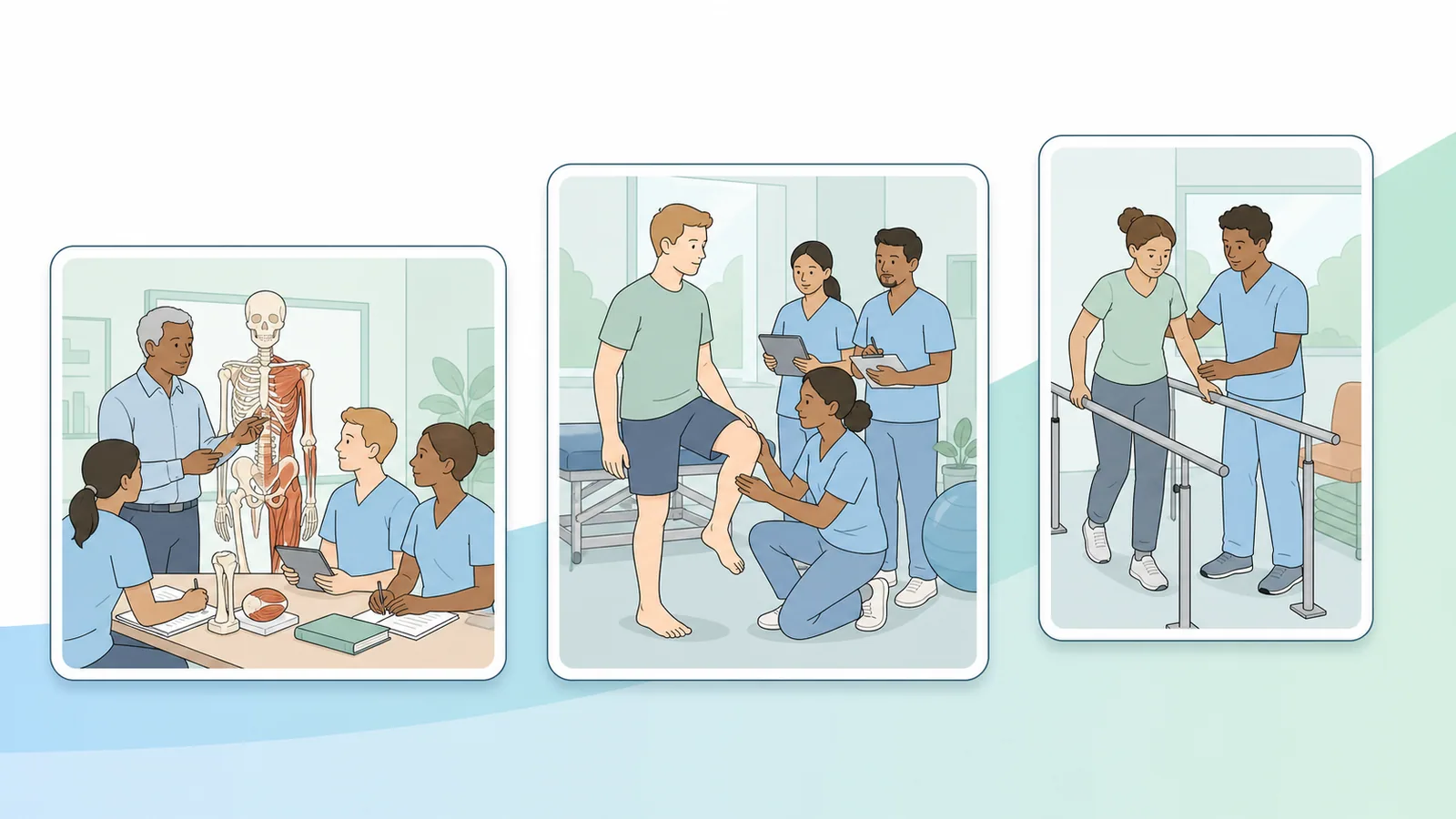
A guide to the university route into physiotherapy, from entry requirements to registration, written by someone who sees what happens to your CV after graduation.
Most people reading this are weighing up whether a physiotherapy degree is worth three years and the tuition fees. Fair question. The course is demanding, places are competitive, and nobody talks honestly about what happens between clicking "accept" on UCAS and landing your first Band 5 job. This is the version I would give you over a coffee.
The two degree routes
There are two ways in through university.
The first is a BSc in Physiotherapy, which takes three years full-time. The second is an MSc Physiotherapy, an accelerated two-year programme for people who already hold a degree in a related subject. Both lead to the same endpoint: eligibility to register with the Health and Care Professions Council (HCPC), which is what allows you to call yourself a physiotherapist and work in the UK.
The BSc is the standard route for school leavers. The MSc suits career changers, often people with degrees in sports science, biology, or biomedical science who want to switch into clinical work.
Entry requirements
Entry requirements vary by university, but the pattern is consistent. For the BSc, most universities ask for three A-levels at around ABB to BBB, with biology usually required or preferred. Some accept BTEC qualifications at distinction grades. You will also need GCSEs in English, Maths, and Science at grade C or 4 or above.
For the MSc, you typically need a 2:1 degree in a related field. Universities define "related" differently, so check each one. Some accept 2:2 degrees with relevant work experience.
Both routes often require evidence of healthcare experience, either paid or voluntary. Admissions tutors want to see you understand what the job involves before committing three years to training for it. A week shadowing in an outpatient clinic is a minimum; sustained experience carries more weight.
You apply through UCAS. Places are competitive, with popular courses drawing around ten applicants for every place, though this varies a lot by institution.
Applying early matters.
What the course covers
A physiotherapy degree is not a typical university experience.
You will spend less time in lecture theatres than your friends studying history, and more time in clinical placements learning to do the job.
The academic content covers anatomy, physiology, biomechanics, and pathology in the first year. You learn how the body moves and what happens when it breaks down. Years two and three layer in assessment, treatment techniques, exercise prescription, and management of specific conditions. Musculoskeletal, neurological, respiratory, and cardiovascular physiotherapy are the core areas.
Throughout the course, you will complete roughly 1,000 hours of clinical placement. These happen in NHS trusts, private practices, and community settings.
Placements are where the classroom content becomes real. You will assess patients, plan treatments, and adapt when things do not go as expected. The feedback is immediate. The learning curve is steep.
Placements are spread across the three years, often in blocks of four to eight weeks. You may need to travel; not all placements are local. Universities arrange them, but you rarely get much choice over location or specialism in the early stages.
Tuition fees and the NHS bursary
As of 2026, tuition fees for a physiotherapy degree are up to £9,790 per year in England. Three years costs roughly £29,400 before living costs.
That is before rent and food.
You can fund this through standard student loans, which you repay only once earning above the threshold.
The NHS Learning Support Fund offers some help. There is a training grant of £5,000 per year, which you do not repay. There is also a parental support payment of up to £2,000 per year if you have children, and a travel and accommodation allowance for placements that are far from your term-time address. These are not the full bursaries that existed before 2017, but they take some pressure off.
For the MSc route, fewer funding options exist. Some trusts sponsor career changers in exchange for a commitment to work for them post-qualification. These are rare and competitive.
Graduation to registration
Finishing the degree does not make you a physiotherapist.
You need to register with the HCPC. Your university will confirm you have completed an approved programme, and you then apply for registration. The process takes a few weeks. Once registered, you can use the protected title "physiotherapist" and begin working.
Registration costs £123 per year to maintain (collected every two years). You will also need to complete continuing professional development (CPD) and maintain a portfolio. HCPC audits a sample of registrants each year, so keeping records matters.
Most graduates move straight into Band 5 roles in the NHS, starting at £32,073 to £39,043 depending on length of service and location. Inner London pays a 20 percent high-cost-area supplement. Competition for first jobs varies by region and specialism; some areas have more vacancies than others.
If you want to see what physiotherapy roles are live right now, including Band 5 posts and specialisms, the physiotherapist job board shows what is out there.
The degree versus the apprenticeship
There is another route in: the physiotherapist degree apprenticeship.
It takes four years, pays a salary during training, and leads to the same BSc and HCPC registration. The trade-off is that places are harder to find, and you are tied to one employer throughout.
The degree is the right choice if you want more control over your placements, faster completion, or if you cannot find an apprenticeship vacancy nearby. The apprenticeship suits people who need to earn while training or who want a job guarantee at the end. Neither is objectively better; they fit different circumstances.
For a fuller comparison of both routes, the pillar guide on how to become a physiotherapist covers the decision in more detail.
FAQ
How long does a physiotherapy degree take?
The BSc takes three years full-time. The MSc, for those with a related degree, takes two years. Both require roughly 1,000 hours of clinical placement.
What A-levels do you need for physiotherapy?
Most universities ask for three A-levels at ABB to BBB, with biology usually required or preferred. Check individual course requirements, as some accept alternative qualifications such as BTECs.
Can I get funding for a physiotherapy degree?
Yes. Standard student loans cover tuition fees. The NHS Learning Support Fund provides a £5,000 training grant per year that you do not repay, plus allowances for travel and childcare.
What can I do with a physiotherapy degree?
You can register as a physiotherapist and work in NHS hospitals, community teams, private clinics, sports settings, or occupational health. Career progression runs from Band 5 through to Band 8 consultant roles. The physiotherapist career path guide covers progression in detail.
Is a physiotherapy degree worth it?
It depends on what you are comparing it to. You will graduate with debt, but the profession offers stable employment, clear progression, and multiple settings to work in. Starting salary in the NHS sits between £32,073 and £39,043, rising to £49,387 or higher at Band 7 within six to ten years. For a full breakdown of physiotherapist salary, see the dedicated guide.