
How to Become a Physiotherapist in the UK
A practical guide to entering the profession: degree vs apprenticeship, what training involves, registration, and what comes after.

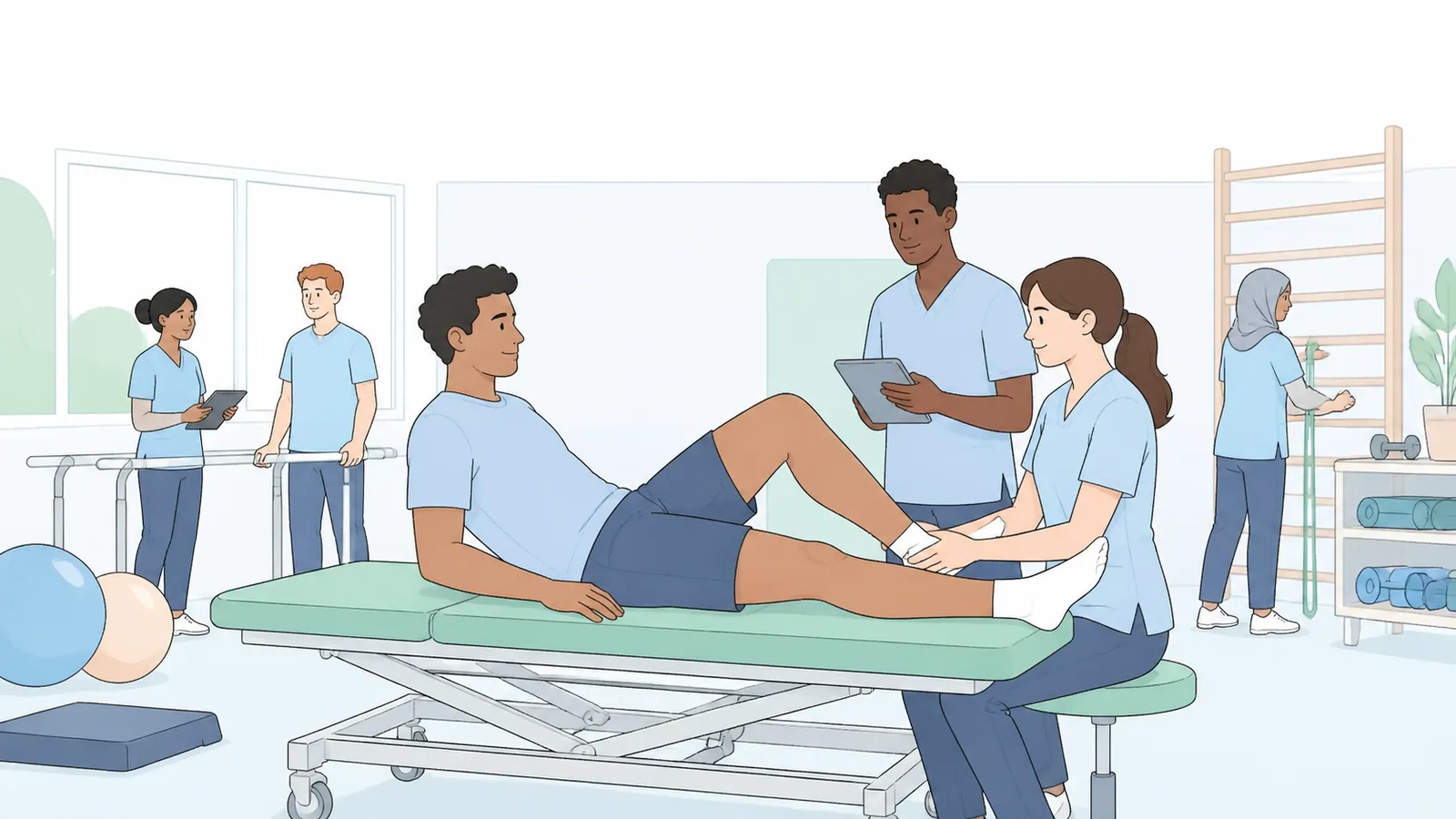
A practical guide to entering the profession, whether you are considering a degree, an apprenticeship, or weighing up one against the other.
Most people reading this are at a crossroads. Perhaps you are finishing school and physiotherapy is on your UCAS list. Perhaps you are already working in health and want to qualify while you earn. This guide covers both routes honestly, with the real entry requirements, what training involves, and what the first years of work actually look like.
Two routes in
There are two ways to become a registered physiotherapist in the UK. Both lead to the same destination: HCPC registration and the right to use the protected title.
The degree route is the traditional path. You study a BSc in Physiotherapy over three years, or an accelerated MSc over two years if you already hold a degree in a related field. Entry requirements vary by university, but most ask for A-levels around ABB to BBB including biology, plus GCSEs in English, maths and science at grade C or 4. Courses mix academic study with clinical placements, typically around 1,000 hours by the time you graduate. You can read more about what the course involves in the physiotherapy degree guide.
The apprenticeship route is newer and often overlooked. The physiotherapist degree apprenticeship (standard ST0519) is a Level 6 qualification, meaning it leads to a full BSc. It runs over four years, with training split between university and a clinical placement employer, usually an NHS trust. Entry requirements are similar to the degree route. The difference is that you are employed throughout, earning a salary while you train, and your fees are covered by the apprenticeship levy. We cover the details in the physiotherapist apprenticeship guide.
Which route suits you?
The honest answer is that neither is better. They suit different circumstances.
The degree route gives you three years of full-time study and the student experience that comes with it. You are not tied to a single employer during training. You can choose placements in different settings and specialisms. The cost is student finance debt, though physiotherapy graduates tend to find work quickly enough that the repayments start sooner than some other degrees.
The apprenticeship route suits people who want to earn while they train, or who are already working in a clinical support role and want to progress without starting again. Four years is longer than three, because you are balancing work and study. Vacancies are competitive and not evenly spread across the country. You will need to secure an apprenticeship position before you start, which is harder than getting a university place.
Both routes lead to the same qualifications and registration.
What training actually involves
Whichever route you take, expect to spend a lot of time learning anatomy, physiology and biomechanics before you get near a patient. The first year of most courses is heavy on theory. You will learn to assess movement, understand musculoskeletal conditions, and study the neurological and respiratory systems.
Clinical placements begin in the second year and grow from there. You will rotate through different settings: outpatient MSK clinics, acute hospital wards, neurorehabilitation units, community teams. The variety is deliberate. Physiotherapy is a broad profession, and the placements let you find out where you want to specialise before you have to choose.
The workload is demanding. Placements are full-time clinical hours on top of academic deadlines. If you are on the apprenticeship route, you are managing coursework alongside the job you are being paid to do. Neither route is easy. The people who struggle are usually those who expected a lighter load because the degree is vocational.
HCPC registration
Once you complete an approved programme, you apply to register with the Health and Care Professions Council. The HCPC is the regulator, and "physiotherapist" is a protected title under UK law. You cannot use it, or call yourself a physical therapist, without being on the register.
Initial registration is straightforward if you have graduated from a UK-approved programme. The renewal fee is £123 per year (collected every two years as £247). New UK graduates pay a reduced rate of £62 per year for their first two professional years. You will also need to complete continuing professional development and keep a record for the HCPC's audit. The qualifications and registration guide covers the process in detail.
Most newly qualified physiotherapists also join the Chartered Society of Physiotherapy, the professional body. Membership is separate from registration but gives you access to insurance, support and a voice on professional issues.
Your first job
The majority of newly qualified physiotherapists start in the NHS at Band 5. As of April 2026, that means a salary between £32,073 and £39,043, with higher pay if you work in London or the surrounding areas. You can check exact figures using the NHS pay calculator.
Band 5 posts are rotational in many trusts. You spend a few months in MSK, a few in respiratory, a few in acute medicine. The rotations are designed to build breadth before you specialise. Some trusts offer static posts if you already know where you want to work.
Vacancies tend to follow graduation season. Most roles go live in spring for September starts. The NHS jobs website is the main source, though some trusts recruit through local links with universities. You can browse current openings at physiotherapist jobs.
Private sector jobs exist for newly qualified physiotherapists, though they are less common. Most employers prefer at least a year of NHS experience first. We compare the two sectors in NHS vs private physiotherapist.
What comes after
Physiotherapy has a clear progression route in the NHS. Band 5 to Band 6 (specialist) typically takes two to four years. Band 6 to Band 7 (advanced practitioner or team lead) takes another four to six. From there, routes split into clinical consultant posts at Band 8, management, education or research.
One route gaining popularity is the First Contact Practitioner role. FCPs work in GP surgeries, seeing patients with musculoskeletal problems directly rather than through referral. These are typically Band 7 posts and require additional training.
The full progression picture is in the physiotherapist career path guide. If you want to understand the pay at each stage, see the physiotherapist salary guide.
FAQ
How long does it take to become a physiotherapist?
Three years for a BSc, two years for an accelerated MSc if you already hold a degree, or four years through the degree apprenticeship. All routes lead to HCPC registration and the right to practise.
Do I need a biology A-level?
Most universities require biology at A-level, or an equivalent such as BTEC or Access to HE with biology content. A small number accept human biology or combined science. Check individual course requirements, as they vary.
Can I train as a physiotherapist while working?
Yes, through the degree apprenticeship. You are employed by an NHS trust or other approved employer throughout the four-year programme. Vacancies are competitive and not available everywhere.
How much does a newly qualified physiotherapist earn?
NHS Band 5 pays £32,073 to £39,043 as of April 2026, before location supplements. Inner London adds around 20%. Use the NHS pay calculator for exact figures based on your location.
Is physiotherapy a good career?
That depends on what you are looking for. The work is varied, physically active and patient-facing. Demand is steady, unemployment is low, and progression routes are clear. The pay is not the highest in healthcare, but it rises predictably through the bands. Read the physiotherapist salary guide for the full picture.